Features Most important features and functionality
Priorities and limits
Set download and upload network priorities or limits for any process.

Automation support
Use various command line commands and web APIs for complete automation.

Rules and filters
Define detailed traffic rules and filters for maximum control.

Geo priorities
Set limits and priorities based on geographic location of the sites and servers you connect to.

Monitor processes
Show all system processes with their download and upload speeds up to connections level.

View history
Detailed download and upload traffic history for any process since first NetBalancer's install.

System tray and toolbar
Show network traffic and other info in a system tray icon or taskbar toolbar.

Support for IPv6
NetBalancer has native IPv6 support for rules and filters.

Tags and bulk commands
Apply tags to your computers and control them with bulk commands like a Pro.

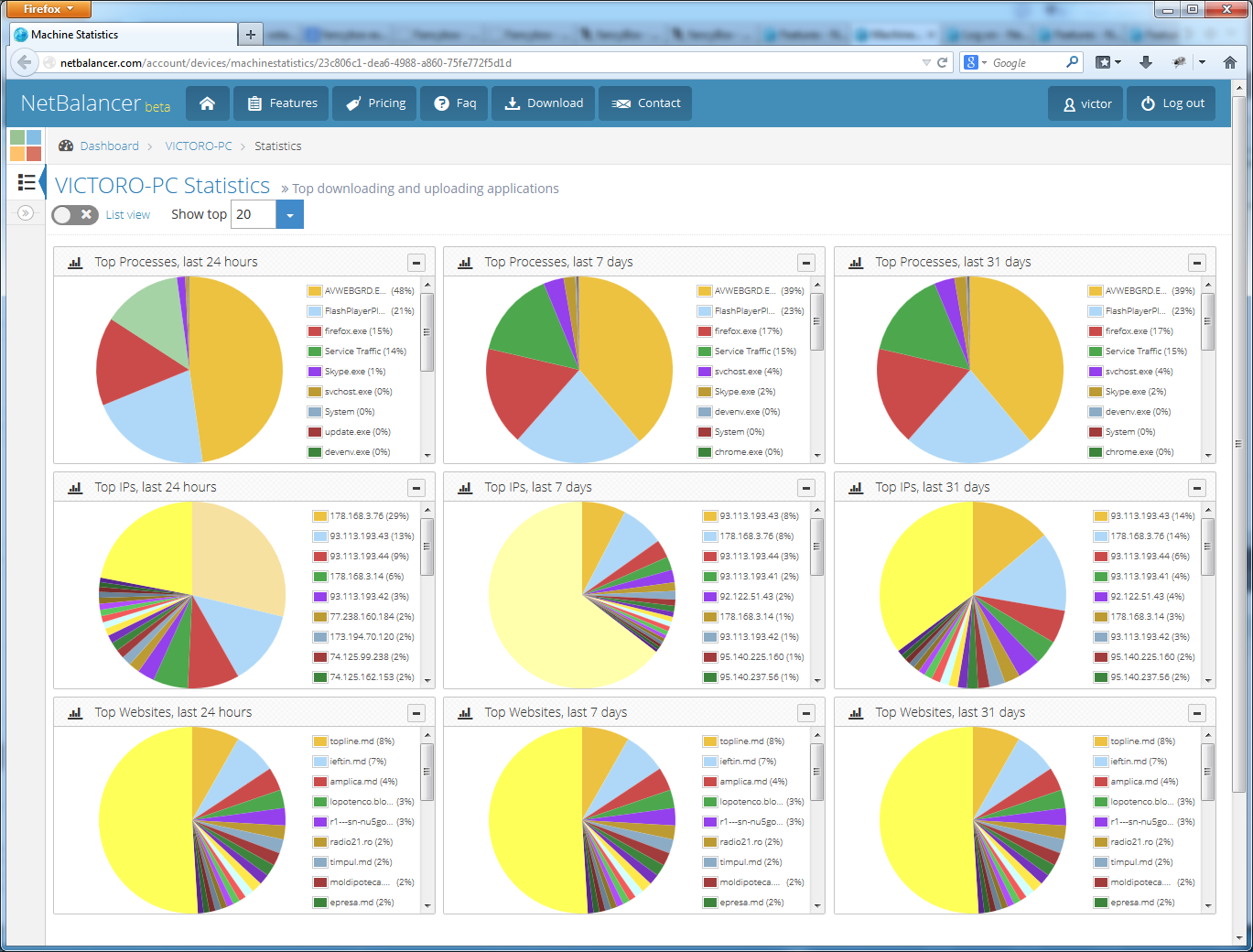
Various traffic charts and statistics
View detailed network traffic charts and statistics.
Encrypted communications
Our website and cloud sync protect communications with encryption, and account passwords are stored as hashes. Configuration files and exports are not encrypted.

All NetBalancer’s Current Features
Traffic Management
Bandwidth Prioritization and Limits
Allows you to control how much bandwidth each application can use by setting download and upload priorities or strict speed limits for any running process. High-priority apps (like streaming or gaming) get network preference, while low-priority ones are slowed down, helping important traffic stay responsive when it competes with less critical downloads. You can also impose specific rate caps to keep programs’ bandwidth use under control. These caps apply to service-managed traffic in their selected scope and count full intercepted frames in aligned one-second windows; a frame larger than the cap can pass alone in an empty byte window. Native Pass filters bypass service limits. When included in the system budget, Ignored traffic can exceed the cap but reduces the capacity left for managed traffic.
Technical Description: NetBalancer employs a kernel-level network driver to intercept and forward packets, while its service applies priority-based scheduling, bandwidth caps, delays and drops. Users can assign predefined priority levels (e.g. High, Normal, Low) or exact rate limits for uploads/downloads via the interface, as shown above. The system cap is shared across adapters. An all-adapters process policy shares one budget across adapters; a policy for one adapter has its own budget there. Per-connection limits apply to each connection separately. A special “Custom” priority mode even enables simultaneous packet delay, dropping, and throttling – useful for simulating poor network conditions (NetBalancer 8.4 with Custom Priorities - NetBalancer). Under the hood, NetBalancer uses high-resolution multimedia timers for real-time traffic shaping. Delaying lower-priority traffic can help adaptive applications get more bandwidth, but it does not guarantee a fixed share or low latency; the result depends on the application and network conditions.
Advanced Traffic Rules and Filters
Offers a powerful rule system to define exactly how and when traffic should flow. You can create custom rules that target specific programs, websites, protocols, or ports – even down to the data inside packets – and decide whether to prioritize, limit, or block that traffic. This gives you fine-grained control; for example, you might block video streaming on a browser but allow everything else, or set a rule to slow down file downloads during work hours.
Technical Description: NetBalancer’s filtering engine examines multiple attributes of each network packet and connection against user-defined criteria for maximum control. You can filter traffic by application process, protocol (TCP/UDP), local or remote port numbers, IP addresses/subnets, or even network adapter/Wi-Fi SSID. The system now exposes packet content to rules as well – for instance, the rule language can inspect the intercepted packet, including its headers (bytes in packet.body[]) to apply different limits based on data patterns or content type. When a packet matches a rule, NetBalancer can assign it a specific priority, impose a bandwidth limit, introduce a delay, or outright block it. Complex scenarios are supported by linking filters with rules via IDs and combining multiple conditions, with native filters processed by the driver and traffic rules evaluated by the service in real time.
Geographic Prioritization & Blocking
Enables location-aware network control by letting you set different policies based on where your internet traffic is going in the world. You can choose to block or slow down connections to specific countries or regions, or give priority to local/regional servers. For example, if you want to restrict downloads from overseas servers or prioritize traffic to servers in your country, Geo controls make setting a policy for an exact location as simple as pointing and clicking on a map; use a CountryCode rule to cover a whole country.
Technical Description: NetBalancer integrates a geo-IP database to determine the geographic location of remote IP addresses for all your connections. It provides the ability to assign limits or priorities based on these locations. In practice, you can create a rule that matches traffic going to (or coming from) a particular country or continent and then apply an action (like “Limit to 1 Mbps” or “Block”) for those connections. The system’s Explore panel (see UI Enhancements below) visualizes this by mapping connections on a world map, and it allows interactive control – you can click on a location on the map and set its traffic priority or block status directly; a CountryCode rule covers a whole country. Geographic rules work in tandem with other filters, and the engine ensures these location-based policies are enforced just as swiftly as any other rule.
IPv6 Support for Rules
Supports modern internet protocols, so if your applications or websites use IPv6 addresses, you can still apply limits and priorities and match traffic by addresses, ranges, ports and protocols.
Technical Description: NetBalancer has native IPv6 support built into its traffic filtering and prioritization system. Process monitoring, address/range rules and native filters recognize IPv6 addresses and networks. ASN and organization metadata are available for both IPv4 and IPv6 from the shipped local snapshot; unknown ranges have no ASN or organization. For example, you can create a filter to target an IPv6 address range or apply a global rate limit to all IPv6 traffic, and NetBalancer will handle it with the same precision as IPv4. IPv4 and IPv6 traffic use the same service policies, while native Pass filters bypass those policies in both families.
UI Enhancements
Process Monitoring & Connection Details
NetBalancer provides a live overview of all applications using your network, along with their current download and upload speeds. You can drill down to see each individual connection a process has open – including the remote IP address or website it’s connected to and what port or service it’s using. This real-time list updates continuously, so you can literally watch which programs are consuming bandwidth and even see details like where they are connecting (with country flags for easy recognition).
Technical Description: The user interface lists every running process and tracks its network usage in real time. Expanding a process reveals a connections panel showing each active network connection that process has, with columns for remote IP, resolved country, port, protocol, and more (as illustrated above). A search/filter box allows users to quickly find specific connections (by IP address, country name, port number, etc.), making it easy to pinpoint traffic of interest. The UI updates these statistics live, querying NetBalancer’s service which monitors socket connections at the OS level. You can right-click on any process or connection to take actions like setting a priority/limit or even terminating the process. This detailed monitoring UI is backed by Windows network APIs and NetBalancer’s driver, enabling deep visibility down to each TCP/UDP stream.
Detailed Traffic History & Statistics
NetBalancer keeps a long-term history of your network usage, so you can analyze how much data each application has used over time. You get various charts and graphs – for example, you can view usage per process for the last hour, day, or even since NetBalancer was first installed. This historical view helps identify trends (like which apps hog the most data) and lets you zoom into specific time windows to see what was happening with your traffic at that moment.
Technical Description: All traffic data is continuously logged by NetBalancer, allowing detailed download/upload statistics for any process since the software was installed. The software’s dashboard includes interactive charts that can display network usage over different time scales (seconds, minutes, hours, days). Users can select a time range and the chart will accurately show the traffic totals for that interval. For finer analysis, hovering over the timeline gives instant per-second or per-minute usage details at that point. NetBalancer can retain a large window of history (up to 1000 data points for each time unit, as per earlier versions’ improvements, and it also provides options to clear or truncate logged data if needed. These historical graphs and statistics are rendered via the UI based on data stored in a local database, enabling in-depth retrospective analysis of network behavior for each process.
System Tray, Toolbar & Mini Window Display
To keep you informed at a glance, NetBalancer can show your network traffic stats right on the taskbar. It has a tray icon (near the clock) that can indicate current upload and download speeds, and even an optional toolbar that sits on the taskbar showing live traffic graphs. For even more visibility, there’s a small floating “traffic mini-window” you can enable, which stays on top of other windows – this mini-window shows real-time download/upload speeds and a tiny graph, and you can customize its appearance (colors, graph type) to your liking.
Technical Description: NetBalancer offers multiple UI elements for at-a-glance monitoring of traffic outside the main app window. It adds a system tray icon and a taskbar toolbar that update in real time with network throughput information. These can display numeric speed readouts or simple graphs so that users always see current bandwidth usage. Additionally, the “Traffic Mini Window” is an always-on-top widget that visualizes live traffic; it can show un-normalized (raw) throughput and supports different graph styles (for example, a bar graph mode). Users can personalize the mini-window’s look — including its graph color scheme — through the settings. All these UI elements draw data from the same monitoring engine, and they’re optimized for modern displays (high-DPI support ensures the tray and mini-window graphics scale cleanly on high-resolution screens (NetBalancer 8.6.1 [Updated] - NetBalancer)). This trio of UI features ensures that whether minimized to the tray or busy with other tasks, a user can always keep an eye on network activity.
Geographic Network Explorer (Map View)
NetBalancer includes an interactive world map that plots all your active connections in real time. This “Explore” panel gives a geographical perspective to your network activity – you can see where in the world your PC is connecting (for example, you might see clusters of servers in particular countries). It’s not just passive; you can click on a location or server pin on the map to get more info or even block or prioritize traffic to that exact location right from the map. Use a CountryCode rule to cover a whole country. It’s a visually intuitive way to understand and manage your traffic based on location.
Technical Description: The Explore panel introduced in NetBalancer 11 visualizes network connections on an interactive globe map. Each active connection from your computer is represented by a line or marker on the map, showing the remote server’s geographic location. The map uses geolocation data (country, city coordinates) for each remote IP to plot these points. It’s fully interactive: users can pan/zoom around the globe and click on a connection’s endpoint to see details like the application using it, the remote host, and data transferred. From the same interface, NetBalancer allows setting priorities or blocks for that location – for instance, clicking on a location and applying a block policy affects connections to those exact coordinates. A CountryCode rule covers a whole country, including its known cities. The Explore panel also features a geo-traffic timeline, highlighting which locations your PC communicated with over recent history and how much data was exchanged. Map actions store a geographic priority or block policy for the selected coordinates. It provides a unique, global view of your traffic and a convenient way to manage network behavior by region.
Multilingual Interface
To cater to users worldwide, NetBalancer’s interface can be displayed in many different languages. You can switch the UI to your native language (options include major languages like English, Spanish, Chinese, Hindi, Russian, and many more) so that menus and settings are easier to navigate. This makes the software accessible and comfortable for non-English speakers, as everything from dialogs to tooltips will appear in the language you choose.
Technical Description: NetBalancer has comprehensive internationalization (i18n) support in its UI, with translations available for a wide range of languages. As of version 12.3, it includes support for over a dozen languages, such as Deutsch, Español, Français, Italiano, Polski, Português, Română, Türkçe, Ελληνικά, Русский, Українська, हिंदी, 中文, and others. The application’s resource files are translated so that all interface elements (menus, labels, messages) appear in the selected locale. Users can change the language on the fly via the settings, and the program will dynamically load the corresponding localization. This multilingual capability was added in response to global user demand and is actively maintained (community or official translations are updated as needed). It ensures that NetBalancer can be used effectively by non-English-speaking users, enhancing usability and adoption across different regions.
Security & Privacy
Encrypted Communications
NetBalancer takes your privacy seriously – its website and cloud sync use encrypted communications. Whether you’re visiting the website or syncing your settings to the cloud, these channels protect your data in transit, helping keep your network control activity private.
Technical Description: Encryption protects NetBalancer’s website and cloud sync communications in transit. The website uses HTTPS. The sync client uses TLS to establish its session and encrypts requests and replies. In practice, this means even if someone intercepts the traffic between your NetBalancer app and the cloud service, they would only see encrypted gibberish. Account passwords are stored as hashes. Configuration files and exports can be plain XML or JSON, or unencrypted ZIP; these files are not covered by transport encryption. Protected communication channels help keep sync data private in transit.
Automation & Scripting
Command-Line Interface and API Automation
NetBalancer can be fully controlled outside its GUI, which is great news for power users and IT admins. It provides a command-line tool and web-based APIs so you can script and automate network management tasks. For instance, you could write a script to automatically change priorities at certain times of day, or integrate NetBalancer’s controls into your own applications or management systems. This automation support means you’re not limited to clicking around the interface – you can make NetBalancer respond to events or schedules hands-free.
Technical Description: NetBalancer offers a rich automation interface through both a command-line utility and a RESTful web API. The command-line tool (nbcmd.exe) allows running various commands and setting parameters from Windows Terminal or batch scripts – for example, one can script commands to set process priorities, create or edit rules, or export/import settings without opening the GUI. This facilitates scheduling via Windows Task Scheduler or integration with other admin scripts. In addition, NetBalancer’s synchronization service provides web APIs (accessible via HTTP requests or through the NetBalancer Cloud dashboard) enabling remote control of multiple machines. These APIs cover operations like adding rules, changing limits, tagging computers, etc., programmatically over the web. Using the web API, an organization could integrate NetBalancer with their existing infrastructure – for instance, automatically applying bandwidth limits to certain servers during peak hours. All automation channels are secured and require authentication, and they mirror the functionality available in the GUI. This dual interface (CLI and API) ensures that anything you can do by clicking can also be done via scripts or remote calls, which is essential for advanced and large-scale use cases.
Programmable Rule Scripting (C#)
For the ultimate in flexibility, NetBalancer lets advanced users write their own mini-programs to decide how traffic is handled. Instead of just using the preset rule options, you can write a rule in C# code that runs for every network packet and makes decisions. This means you can create very complex or specific behaviors – essentially if you can logic it out in code, you can have NetBalancer enforce it. It’s a feature aimed at power users who might say, “I want to do something that the normal interface doesn’t let me” – with programmatic rules, you can implement those custom policies by scripting them yourself.
Technical Description: NetBalancer’s Programmatic Rules feature allows users to define traffic rules entirely in C# code. These scripts are compiled just-in-time and each evaluated rule runs at most once per packet, using a function to determine if the packet matches certain criteria and what action to take. The scripting environment exposes packet properties and context (e.g., protocol, ports, application) and provides functions like normal(), limit(), block() etc., to assign priorities or actions to packets. Rules with identical code share Context state, with the current rule fields prepared for each invocation. In a local x64 measurement, a rule checking a 42-byte packet body, remote port and current rule name ran at about 621,000 evaluations per second, including packet and Context preparation for every invocation; setup, compilation and warm-up were excluded. This rate measures rule evaluation and does not establish network throughput. These scripts run with the service’s elevated trust, so use only rule code you trust; they are not a security sandbox. This feature effectively turns NetBalancer into a programmable firewall/shaper, where users with coding skills can implement bespoke logic that goes beyond the built-in rule sets. All the support code and examples for programmatic rules are provided openly (under MIT license) to encourage customization and transparency.
Cloud Sync and Bulk Management
NetBalancer isn’t limited to a single PC – it can sync settings across your devices and let you manage them collectively. By logging into a NetBalancer account, all your rules and preferences can be synchronized to the cloud and applied on multiple computers. You can organize your PCs into groups using tags (for example, tag some machines as “Office” or “Family”) and then issue a single command to apply a rule or limit to all tagged devices at once. This bulk management is a boon for IT administrators or anyone with several computers, as you don’t have to configure each one by hand – set it up once, and propagate the changes to all your machines in one go.
Technical Description: NetBalancer provides a cloud-based sync service that enables central management of multiple installations. When signed in, a user’s NetBalancer client will upload and download configuration changes (priorities, rules, settings) to keep all their devices in sync. An important feature of this service is the use of tags: you can assign custom tags to each of your computers (e.g. “Lab PCs”, “Work Laptops”, etc.) and then execute bulk operations targeting those tags. For instance, an admin could tag 5 computers as “Team A” and then issue a single bulk command (via the web interface or one of the linked clients) to set a new download limit on all “Team A” machines simultaneously. These bulk commands are processed by the NetBalancer cloud, which sends the instructions to each tagged device’s local service. All sync traffic is encrypted (as noted in Security & Privacy) to protect the configurations in transit. The result is a coordinated network control system: changes made on one device (or on the web dashboard) can automatically propagate to others, ensuring consistent policy enforcement across a fleet of PCs. This makes NetBalancer suitable not just for individual use but also for multi-computer environments, simplifying network administration tasks through automation and synchronization.